
Sex Offender Checks in San Juan County
The San Juan County Sheriff sex-offender registration page is the local starting point. It links into OffenderWatch with the county office identifier already set. The county says the tool accepts an address and a radius, then returns real-time information about registrants who are eligible for public disclosure. That wording matters. OffenderWatch is a public-notification view, not a complete list of every person who has a duty to register with the Sheriff.
A searcher has four official routes. Use OffenderWatch for a place-based San Juan County search. Call or visit the Sheriff when the concern involves registration, compliance, or a result that needs local context. Use the Washington State Patrol system for the state repository function, and use the national public registry for a search that crosses state lines. Washington Access to Criminal History can include registered sex and kidnapping offender information within a broader paid conviction-history result, but it is not a substitute for the county's live address-and-radius notification tool.
Begin with a precise location rather than a broad assumption about an island or town. Friday Harbor is the county's only incorporated town, yet the Sheriff's responsibility spans the county. A blank public map result can have several explanations, including disclosure level, search geography, update timing, or the limits of the public categories.
San Juan County Registry Roles
The Washington State Patrol and the San Juan County Sheriff hold different parts of the registry process. A person who must register supplies the required information to the sheriff in the county of residence. Additional duties can arise when a nonresident works, attends school, or has a vocation in the county. The Sheriff then forwards registration information to the WSP central registry. The central file and the local public notice are linked, but they are not the same product.
Washington law separates four ideas that are easy to blur. Registration is the person's legal duty. Central registration is WSP's repository role. Risk classification helps control disclosure. Community notification is the Sheriff's lawful release of information. San Juan County OffenderWatch publishes only the part authorized for public view, so its coverage should never be described as the full central registry.
- Registration
- Required information supplied to the Sheriff under state law.
- Risk level
- An assessment used to guide the scope of community notice.
- Public notification
- Information the Sheriff may release under Washington disclosure law.
- Duration
- The period set by offense, history, dates, and any available court relief, not by risk level alone.
How to Search the WSP Offender Registry
Public access to San Juan County registry information runs through the Sheriff's OffenderWatch gateway rather than a direct browse of the full WSP central file. The vendor needs JavaScript, and its automated interface blocked a full field inventory during research. Only the address-and-radius route is verified. Exact radius choices, name fields, and other filters must be read from the live screen rather than assumed.
- Open the official San Juan County registration page and follow its OffenderWatch emblem. This keeps the search tied to the correct Sheriff's office.
- Enter a real address and select one of the radius choices shown in the live tool. Do not rely on an old screenshot for current menu values.
- Read the result labels and county disclaimer before reaching a conclusion. Public absence is not proof that no registration duty exists.
- For a concern about a specific entry, call the Sheriff at 360-378-4151. Use emergency channels only when there is an immediate danger.
| Search field | Control | Required | Verified scope |
|---|---|---|---|
| Address | Location entry | Used for local search | Confirmed by San Juan County |
| Radius | Live menu | Selected with address | Available, but exact choices were blocked from automated inspection |
| Name or other filters | Not verified | Not established | Check the current interactive screen; do not infer fields |
| Office coverage | County-linked gateway | Built into link | Preserves the San Juan County office identifier |
Note: The failed vendor screenshot is not used because the manifest marks it unusable and research could not verify the interface controls.
San Juan County OffenderWatch Updates
The county describes OffenderWatch as real-time information that changes throughout the day when the Sheriff updates an address or other information. That does not mean each browser view proves current compliance. It means the public display can refresh after the local office makes a change. Save the date and search location if a result must be discussed with the Sheriff, since a later search may not look the same.
The official county gateway shows the disclaimer and correct entry route before the vendor search. The captured image documents that gateway without exposing a person's profile.
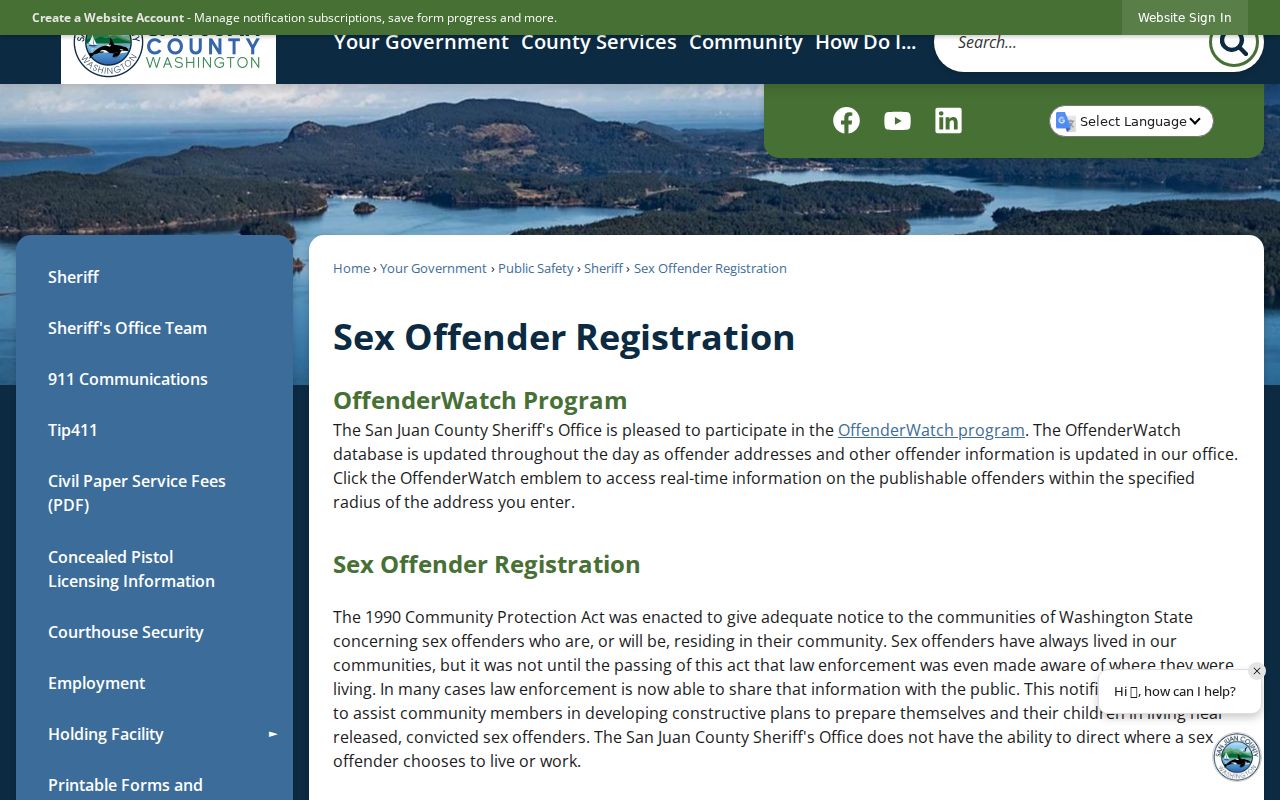
This neutral view helps a San Juan County searcher confirm the official source while avoiding the misuse of identifiable registry images.
Inside a Registry Profile
A live registry profile should be read exactly as shown. The research process could not inspect an individual OffenderWatch record because the vendor blocked automated access. For that reason, no claim is made that a San Juan County profile always displays a photograph, exact address, vehicle, tattoo, workplace, victim details, or a fixed set of offense fields. Those items must not be copied from another county's vendor layout.
The verified profile inventory is therefore an access-and-scope table. It tells a reader what San Juan County and Washington law support, and it marks the fields that remain unverified. When the live screen supplies a label, keep its wording and note the date of access.
| Published population | People eligible for public disclosure under Washington risk-level rules, not every registered person. |
|---|---|
| Search basis | San Juan County confirms an address-and-radius search. |
| Current labels | Read from the live interactive profile; the exact field set was not verifiable during research. |
| Update timing | The county says information updates throughout the day as the Sheriff changes it. |
| Public absence | May reflect disclosure limits, geography, timing, or an excluded public category. |
| Wanted status | A listed person is not necessarily wanted by law enforcement. |
San Juan County Registry Level I Disclosure
Level I does not mean that a person has no registration duty. Nor does it promise a public map entry. Under RCW 4.24.550, low-risk information is generally shared through specified law-enforcement, school, and request-based routes instead of blanket public posting. A no-result screen cannot settle whether a named person is registered.
Level II permits wider notice to defined organizations and nearby recipients. Those may include schools, child-care providers, libraries, groups that serve vulnerable people, and nearby community members. Level III permits public-at-large notice and requires the Sheriff to publish community notification. Transient or homeless circumstances have their own statutory notice provisions. These categories explain visibility. They do not set how long registration lasts.
Note: Washington calls these risk levels, not public tiers, and the labels should not be converted into a duration chart.
Washington Registration Levels and Requirements
Washington assigns risk for disclosure while RCW 9A.44.140 sets duration through a separate analysis. Offense and class, jurisdiction, prior registrable convictions, the release or judgment date, later disqualifying convictions, and a possible petition all can matter. Risk level never supplies a safe one-line answer to duration.
| Risk level | Public visibility | Registration duration |
|---|---|---|
| Level I, low risk | Limited statutory and request-based disclosure; not blanket posting | Not set by Level I; apply RCW 9A.44.140 to the person's facts |
| Level II, moderate risk | Notice may reach defined organizations and nearby recipients | Not set by Level II; offense, history, dates, and relief control |
| Level III, high risk | Public-at-large community notification | Not set by Level III; longer or lifetime branches may apply under the statute |
| Transient circumstances | Special public-notification provisions may apply | Status does not itself create a duration formula |
One narrow path shows why care is needed. A qualifying adult Washington class C or listed conviction, with no prior sex or kidnapping conviction, may end after ten consecutive years in the community without a disqualifying conviction, measured from the last release or judgment. Other branches use fifteen-year, lifetime, or petition-based rules. It would be false to summarize that example as “Level I equals ten years.”
San Juan County Registration Deadlines
RCW 9A.44.130 contains event-specific registration duties. Common three-business-day triggers include release from custody, a sentence when the person is not confined, moving or returning to a residence, and certain periods of extended presence. The full statute should be checked for the facts at hand because each event has its own wording and conditions.
A person may also have to register in San Juan County when living elsewhere but working, attending school, or carrying on a vocation here. The releasing agency has a forwarding role, the Sheriff has local registration duties, and the Sheriff sends information to the WSP central registry. These steps can occur on different dates. A public update time should not be treated as the statutory filing time.
For a question about a San Juan County duty, use the Sheriff's official contact page or call 360-378-4151. Headquarters is at 96 Second Street in Friday Harbor. The same phone serves the Orcas and Lopez Sheriff substations, which matters for residents who cannot readily reach the county seat.
San Juan County Cross-State Registry Search
The Dru Sjodin National Sex Offender Public Website, or NSOPW, supplies the national public-search layer. It is useful when a location question crosses Washington's border or when the originating jurisdiction is unclear. NSOPW brings participating public registries into one search route, but the source jurisdiction still controls its definitions and disclosure rules.
The national search image comes from the official NSOPW interface and contains no selected person. It shows the right cross-state starting point without turning a registry check into an independent accusation.
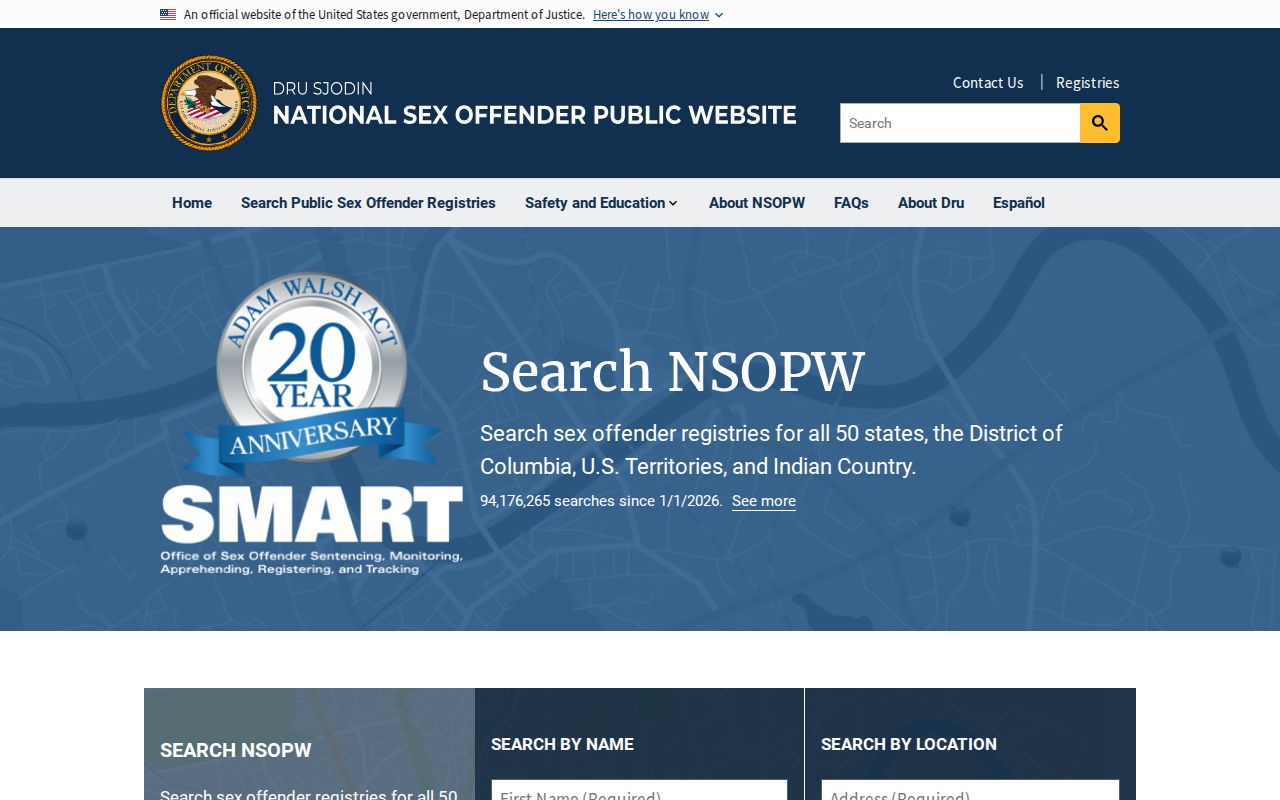
A result should be opened through its originating agency and read under that jurisdiction's terms, since a risk label from another state may not match Washington's levels.
Reporting San Juan County Registry Noncompliance
A safety concern calls for verification, not direct action. The Sheriff asks the public to report suspected failure to comply. A listed person is not necessarily wanted, and a person missing from the map is not necessarily out of compliance. Both conclusions require more than the public display can prove.
- Record the location, time, and the exact public label that caused concern. Do not follow or confront anyone.
- Call the San Juan County Sheriff at 360-378-4151 and describe the facts without posting an independent claim.
- Use an emergency channel only for immediate danger. Let law enforcement determine registration or wanted status.
The county's island geography makes the direct channel useful. Sheriff headquarters is in Friday Harbor, with substations on Orcas and Lopez. Registration records still flow to the same county office and then to the state central registry.
Community Notification and Lawful Use
Community notification under RCW 4.24.550 supports awareness and safety planning. It is not a license to contact a registrant, threaten a household, stage surveillance, or spread claims that the official record does not make. San Juan County states that threats, intimidation, and harassment are not tolerated and can be prosecuted. The Sheriff also says it cannot direct where a registrant lives or works.
Use public information to understand an official notice and choose sensible safety steps. Check the source date, read the risk level as a disclosure category, and bring a compliance question to law enforcement. Do not treat a map marker as proof of a new crime, and do not treat an absent marker as proof that no legal duty exists.
Registry misuse warning: RCW 4.24.550 authorizes lawful community disclosure, not harassment. San Juan County warns that threats, intimidation, or harassment can be prosecuted; never contact, follow, threaten, or target a registrant or household.