
San Juan County Criminal Court Cases
Two courts divide the local criminal caseload. San Juan County Superior Court hears felony matters. San Juan County District Court hears misdemeanors and gross misdemeanors, along with traffic and nontraffic infractions. Friday Harbor does not operate a separate active municipal court. The state court directory routes Friday Harbor matters to County District Court, so a town citation or misdemeanor case does not require a second city docket search.
Both courts sit on the second floor of the San Juan County Courthouse at 350 Court Street in Friday Harbor. The County Clerk is the custodian of Superior Court case files. District Court maintains its own limited-jurisdiction records. That split matters when asking for a document. A felony judgment belongs with the Superior Court clerk, while a District Court misdemeanor file stays with that court. The county's District Court page confirms the court's jurisdiction and public counter details.
The linked image comes from the county's official District Court page.
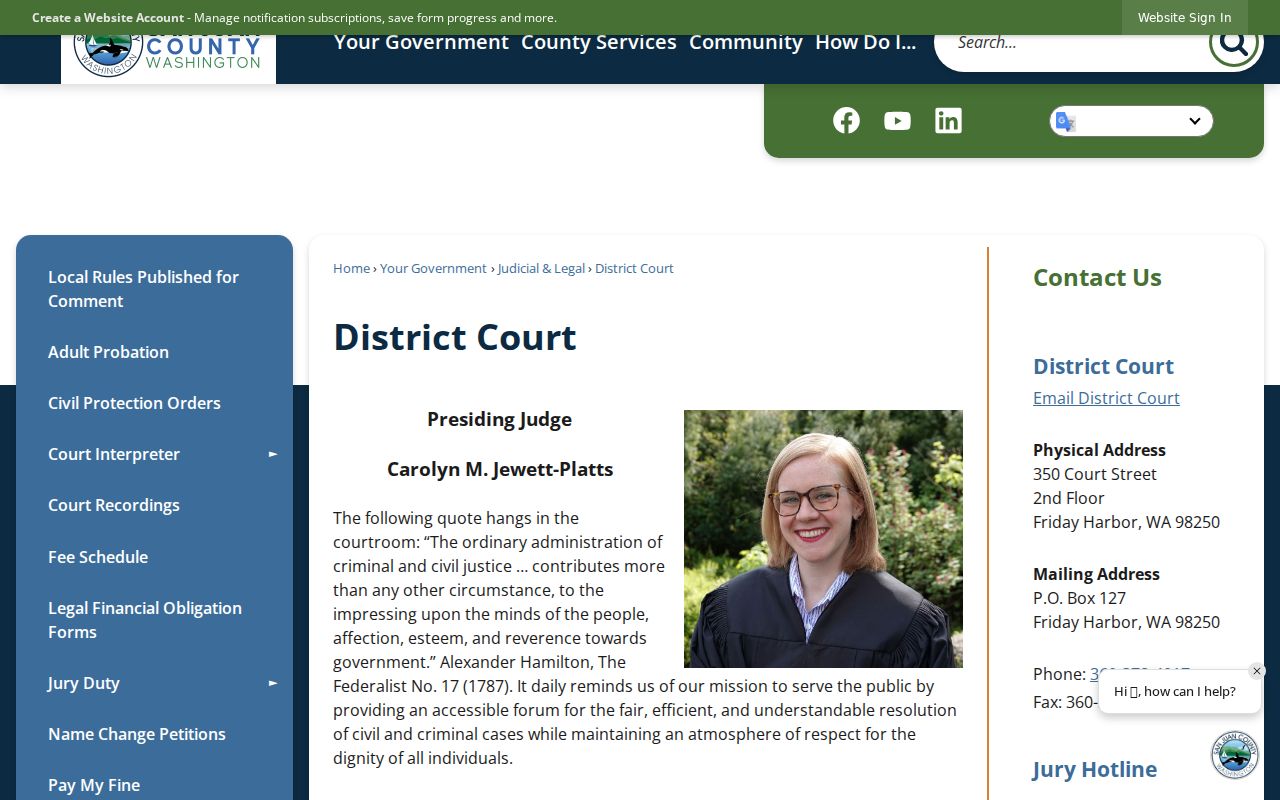
It helps a reader match a misdemeanor or gross-misdemeanor file to the right San Juan County court before making a request.
San Juan County Court Jurisdiction
Washington's offense classes point to the court of record. Class A, B, and C felonies proceed in Superior Court. Gross misdemeanors and misdemeanors proceed in District Court. Under RCW chapter 9A.20, those labels carry different statutory maximums, but the class alone does not predict a sentence. Offense history, the charged law, later amendments, and the judgment all matter.
The San Juan County Prosecuting Attorney represents the state in adult and juvenile criminal cases and decides what charges to file after reviewing an investigation. The office also supports victims and conveys concerns about safety, restitution, and sentencing. A person who qualifies for appointed counsel uses the county's confidential Public Defender screening channel. These offices take part in a case, but neither replaces the court clerk as the source for filed pleadings, orders, and the final judgment.
Note: The arresting officer's charge label, the prosecutor's filed count, and the conviction offense may all differ in one San Juan County case.
Searching San Juan County Case Records
Begin with the free Washington Courts Case Records Search. It covers District, Municipal, Superior, and appellate paths, and it refreshes about once each day. The public result is reference material. It can locate a case number, court, filing date, and case type, but it is not the official court file and excludes sealed or confidential matters.
- Open the state case-search page and choose District and Municipal or Superior, based on the level of charge.
- Select San Juan County District Court or San Juan County Superior Court from the court list.
- Search by a party's first and last name, or use the case number when it is known.
- Narrow a broad result with the case type or filing-year filter, then note the court and full number.
- Use that reference to inspect the file or request the exact pleading, order, judgment, or hearing record from the court.
| Field Label | Type | Required | Notes |
|---|---|---|---|
| Court level tab | Tabs | Yes | Choose District and Municipal, Superior, or Appellate. |
| Court Name | Dropdown | For local search | Select the San Juan County court that holds the case. |
| First and Last Name | Text | On name search | Middle name may be optional; accurate spelling helps. |
| Case Type and Year | Filters | Path-dependent | These narrow common names and older results. |
| Case Number | Text | On number search | Superior criminal cases use case-type digit 1. |
| CAPTCHA | Challenge | Yes | The public search requires its verification step. |
The official state-search image shows the Washington court lookup entry point.
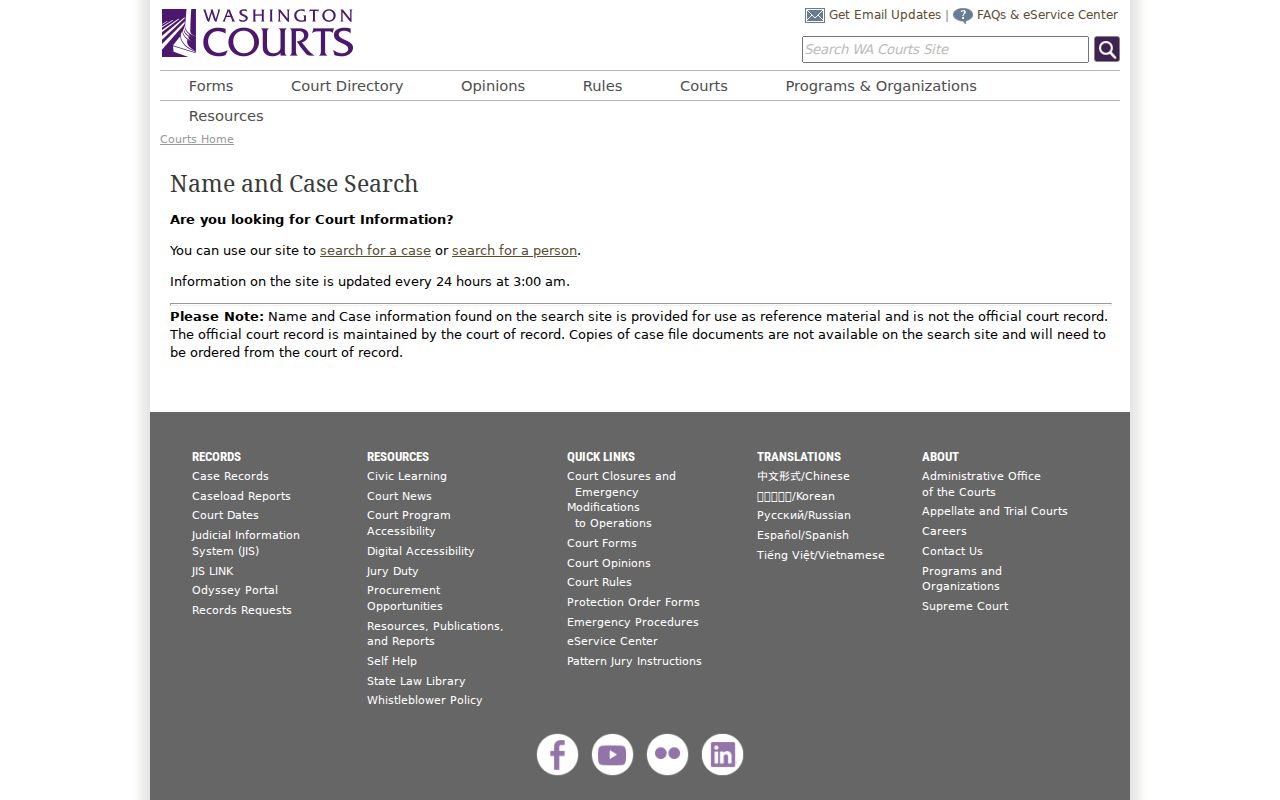
The screen reinforces why choosing the correct court level and San Juan County court is part of an accurate case search.
San Juan County Odyssey Case Search
Odyssey Portal supplies a second path for San Juan County Superior Court metadata. Its Smart Search accepts a record number or party name. Search is not case-sensitive. A wildcard uses partial text followed by an asterisk. The published guidance calls for at least one character of a first name, three of a last name, or four of a case number before the wildcard.
Anonymous users can review public case information, but they cannot open document images or restricted cases. A San Juan Odyssey number ends with county code 28. That code identifies the county. It is not the criminal case-type digit used within the statewide Superior Court number. Keeping the two number formats distinct can prevent a failed search.
The Odyssey Smart Search source provides the portal view assigned to San Juan County court cases.
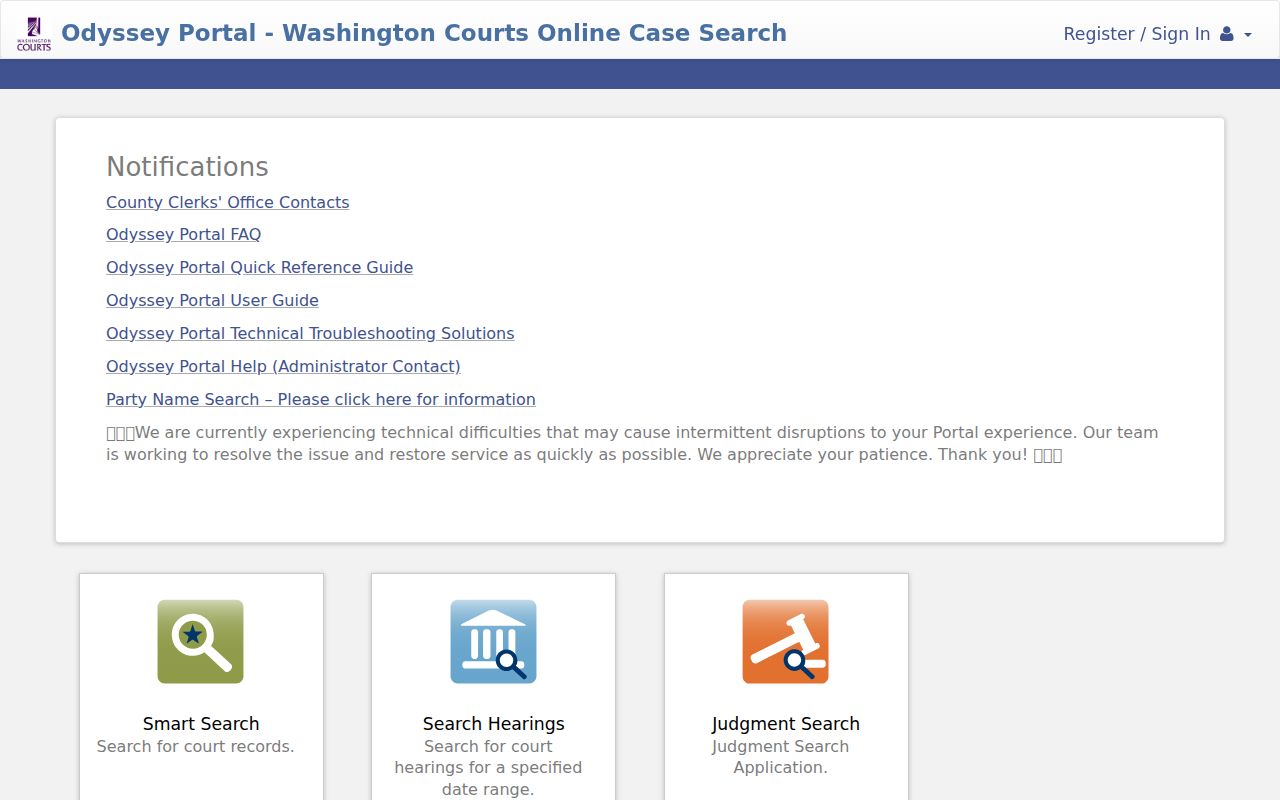
Use Odyssey to locate Superior Court metadata, then move to the clerk when the actual filing or a certified result is needed.
San Juan County Court File Copies
The official Superior Court file can be viewed free at the clerk's public terminal. The counter is on the courthouse's second floor and is open weekdays from 8:30 a.m. to 4:30 p.m., with a noon to 1 p.m. closure. The clerk's mailing address is 350 Court Street #7, Friday Harbor, WA 98250, and the phone number is 360-378-2163. The County Clerk court-records page explains file viewing, document requests, subscriptions, and prices.
For a copy request, give the cause number, case name, and exact document or audio hearing sought. The request form accepts delivery, mail, or email submission, but the clerk does not take copy requests by phone. Ordinary paper or emailed copies cost $0.50 per page. Certification costs $5 for the first page and $1 for each added page. A digitally recorded hearing link costs $25 per hearing. The form distinguishes non-certified, certified, and authenticated copies, so select the type that matches the intended need.
The official clerk-records source is shown in the assigned image.
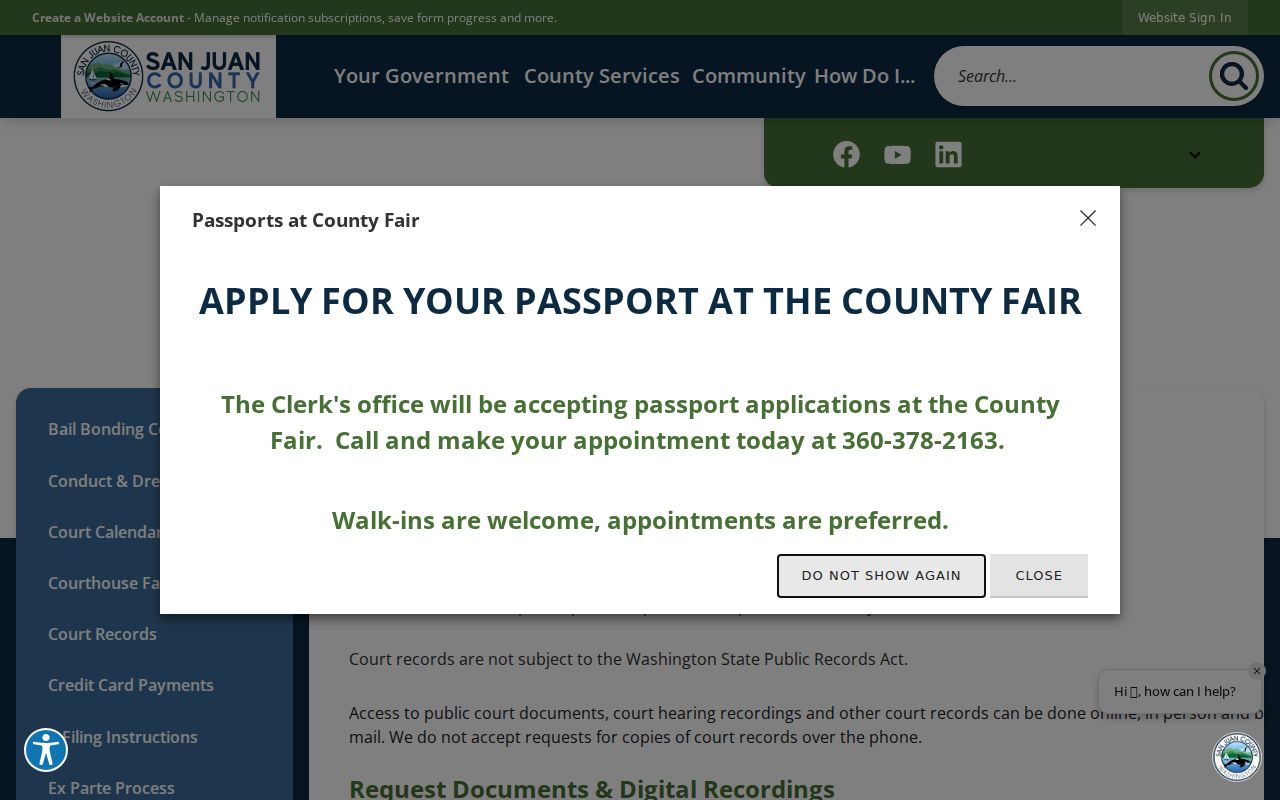
This local channel turns an online case reference into a viewable or certified San Juan County court document.
Inside a San Juan County Case File
A criminal case file tracks what was filed and what the court did. It is not the same as a Sheriff's incident report or a custody record. The charging document states the counts presented to the court. Docket entries mark filed papers and hearings. Orders can change release terms, hearing dates, or the charges still at issue. The judgment and sentence give the clearest filed account of disposition and punishment.
| Case Number and Court | Identifies the filing year, court level, case sequence, and local court of record. |
|---|---|
| Charging Document | Lists the offense counts filed by the San Juan County Prosecuting Attorney. |
| Docket Entries | Chronologically logs pleadings, motions, orders, and court events. |
| Hearing Dates | Shows scheduled or completed proceedings, subject to later calendar changes. |
| Disposition and Judgment | Records dismissal, acquittal, plea, trial result, or other final action. |
| Sentence and Conditions | States custody, financial obligations, supervision, and court-ordered terms when applicable. |
A public portal summary may not display the exact charge, judge, bond, financial balance, document image, or full sentence. Those details should be checked in the San Juan County file. A certified clerk copy proves that the document came from the court, while an online status is only a reference.
San Juan County Docket Meaning
A docket entry labeled filed marks the start or receipt of a matter. It does not prove the charge remained unchanged or led to a conviction. A prosecutor can amend or dismiss a count. A warrant entry may stay in the event history after the warrant has been recalled. The later signed order or judgment carries more weight than an isolated status line.
- Arraignment
- The hearing where the charge is presented and a plea is entered.
- Disposition
- The recorded outcome, such as dismissal, acquittal, guilty plea, or trial conviction.
- Judgment
- The court's formal decision that documents the result and supports later verification.
- Certified copy
- A clerk-issued copy bearing court certification, not merely a portal printout.
When a portal result and another criminal-history source conflict, save the case number and obtain the judgment. If a WSP record still lacks the court's disposition, the official court order can support WSP's inspection and challenge process.
Note: A blank public search result may reflect a sealed case, a data gap, a spelling issue, or the wrong San Juan County court.
How a Criminal Case Moves
A law-enforcement report can reach the San Juan County Prosecuting Attorney after an arrest or investigation. The prosecutor then decides whether to file charges and what counts to present. Once filed, the case receives a court number and docket. At arraignment, the court advises the accused of the charge and receives a plea. Pretrial work can include motions, discovery, negotiations, and calendar settings before a plea or trial resolves the disputed counts.
Case flow: Charges Filed › Arraignment › Pretrial › Plea or Trial › Disposition › Sentencing
Each stage creates a different record. A motion does not show the result. A plea entry may precede the final judgment. Sentencing terms can appear in a later order. Reading the sequence, rather than one entry alone, gives the clearest view of a San Juan County criminal case.
San Juan County Court Calendars
Local scheduling gives docket entries useful context. Superior Court lists criminal law and motion on Monday at 9:30 a.m. Dependency and Therapeutic Court alternate at 1:15 p.m., and juvenile criminal matters are set at 2:30 p.m. In-custody hearings can occur as needed. These times explain why several San Juan County case events may cluster on Monday, but the live court calendar still controls because schedules can change.
District Court publishes Microsoft Teams instructions for remote appearances. Protection-order participants are directed to call 360-378-4017 or email districtcourt@sanjuancountywa.gov. A remote access instruction is not permission to miss a hearing. Confirm the current setting with the court shown on the notice or docket.
San Juan County Vacating Records
Washington calls this relief vacating a conviction, and sealing is a separate access action. The San Juan County filing guide directs a person to choose the state form, gather case and docket information, contact the sentencing court, make copies, set a hearing, file the originals, and serve the prosecutor on the same day. If relief is granted, the clerk sends the order to WSP and local law enforcement.
Misdemeanor and gross-misdemeanor vacation is governed by RCW 9.96.060, while felony vacation is governed by RCW 9.94A.640. Eligibility depends on the offense, completion, waiting periods, other pending charges, and statutory exclusions. A granted vacation should not be described as erasing every trace from every system.
The local vacation source appears in the assigned San Juan County image.
Its local sequence links the right form and order to the San Juan County sentencing court that holds the criminal case.
Case Record Access & Restrictions
Washington court case files are accessed under court rules, chiefly GR 31. They are not records governed by the Washington Public Records Act. That distinction sends a San Juan County criminal pleading, order, or docket to the clerk or District Court, not to the county's central PRA officer. The PRA remains relevant to Sheriff and other county agency records, but a public-records request cannot override a court seal.
Anonymous Odyssey access does not include documents. The free courthouse terminal offers public file viewing, while the clerk supplies ordinary, certified, or authenticated copies. Registered users who need ongoing access can consider JIS-Link, which provides display-only docket data and no documents, or a County Clerk document subscription. The county lists annual subscription tiers from $100 for one to three users through $600 for up to fifteen users.
If a San Juan County case does not appear online, verify spelling, court level, and filing year before contacting the court of record. Ask whether an older index gap or access restriction applies. During Washington's November 2024 court-database outage, the county warned residents that the statewide system was unavailable. That event shows why an online absence should never be treated as proof that no case exists.